Meta DAX › Trainer › Walkthrough
What you’ll see: building a course, from one paragraph to a finished week.
First published 2026-10-10.
Run once on a made-up brief: a five-day induction for a small bakery. Two plain prompts do the work in the AI subscription you already have — MP-11, the curriculum architect, designs the course; MP-12, the batch builder, builds it a day at a time, grounded in your own process. The finished version is First Week at the Bakery; the very same recipe, aimed higher, is The Proton Mill, a university unit. This is one way through; it is never the only way.
-
1 Write the brief — one paragraph. What people should be able to do, who they are, and what it must match.
What you see: it reads the paragraph back and asks only for what it genuinely needs — here, the source your course must match.
You pasteOPERATION: CURRICULUM (MP-11, the curriculum architect)
CONFIG: mode design, size strand, language English, clarify_round 1
INPUT: A five-day induction for new floor staff at a small bakery (about 8 staff). By the end they can open and close the shop, handle food-safety basics, and deal with a complaint without a manager. Today new starters skip the closing checklist. One session a day, people on their own devices.Your assistantReading that back: a five-day induction for new bakery floor staff — open and close, food-safety basics, and handling a complaint — one session a day, on their own devices, with a known gap on the closing checklist. One thing I need: is there a closing checklist or food-safety sheet this must teach exactly, word for word? If so, paste or name it and I’ll keep those steps verbatim.
YouYes — here’s the closing checklist and the allergen sheet.
-
2 Read the designed course — the whole week as five days, each with a clear outcome.
What you see: the ordered plan end to end, with the known gap built in as its own day and the parts that must be exact kept verbatim.
first-week-at-the-bakery (strand)  —  5 days, 1 session each
  Day 1  Welcome — who we are and how we work
  Day 2  Food-safety basics — hands, allergens, temperatures   [verbatim sheet]
  Day 3  The opening and closing checklist                        [verbatim list]
  Day 4  Customer service and handling a complaint
  Day 5  Safety — knives, ovens, slips, and who to tell

Each day → Learn → Do the activity → Check → Manager's note.
Day 3 carries the closing checklist as a drag-to-order task, because
that's the step new starters skip.
-
3 Build one day. The builder plans the day’s units and hands you the first to run.
What you see: an ordered, resumable build list, then one unit at a time — built through a realistic shift, not a generic example.
You pasteOPERATION: BUILD (MP-12, the batch builder)
CONFIG: mode plan, review_gate human
INPUT: just Day 3 this run.Your assistantBuild plan for Day 3 — opening and closing:
1. the day’s tree (done once)
2. Learn — why the order matters
3. Do — drag the closing steps into order (your checklist, verbatim)
4. Check — 3 questions
5. Manager’s note — a show-list and a sign-off block
Say next for the first unit. Say stop any time — nothing is left half-written.Younext
Your assistantNext unit: the Day 3 activity. A drag-to-order closing checklist built from your exact steps, a 3-question check, and a manager’s sign-off block. Running it now…
-
4 See the finished course. Five days, each with a hands-on activity and a sign-off.
What you see: the whole induction as a working course — this is what day one of your brief grows into.
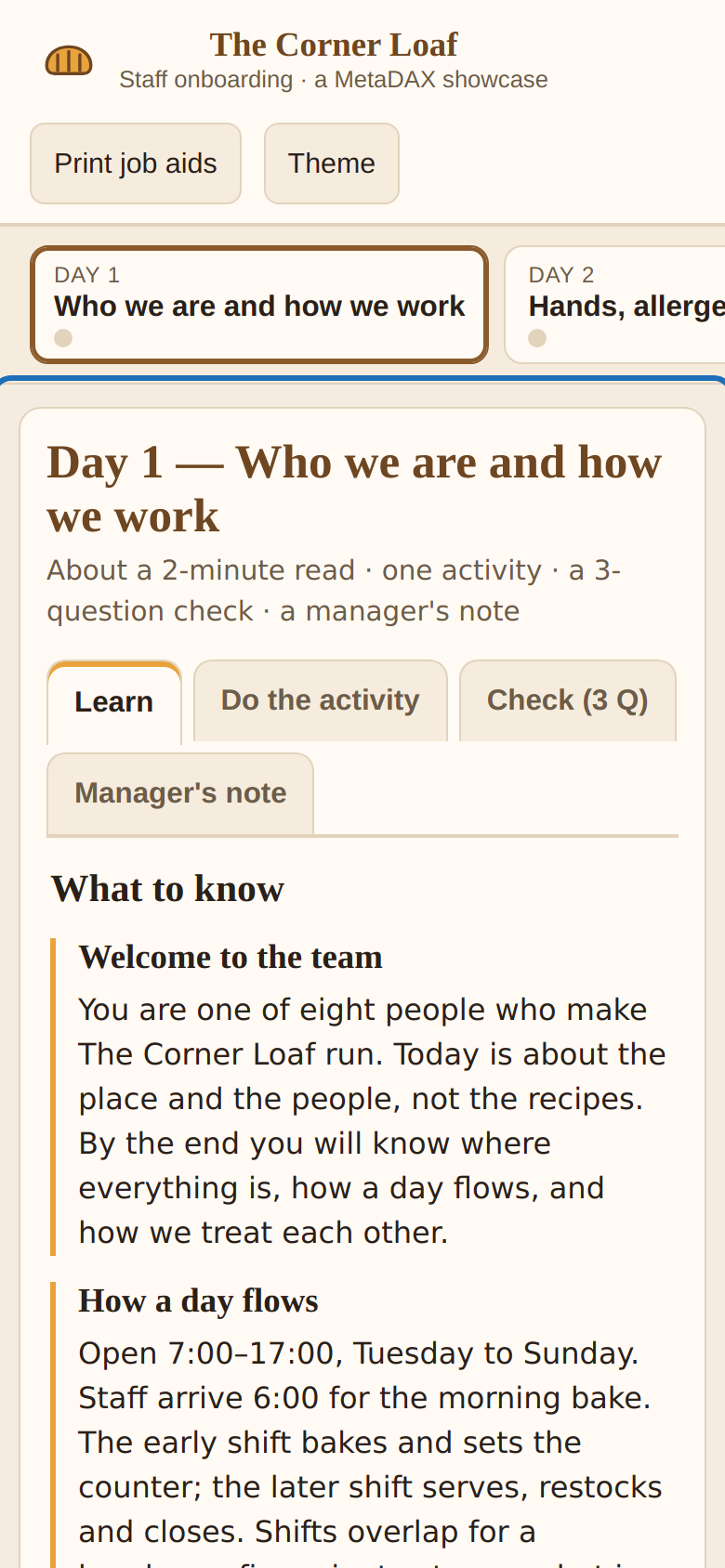 Open this screen: First Week at the Bakery
 The finished version: First Week at the Bakery — five days, each with Learn, an activity (a shop-floor plan, an allergen matcher, the drag-to-order closing checklist, a complaint scenario, a spot-the-hazard scene), a short check, and a manager’s note. Everyone in it is made up. -
5 Aim the same recipe higher — a university unit comes out of the identical two prompts.
What you see: nothing about the method changes; only the brief does. A one-paragraph brief for a first-year biology unit builds this.
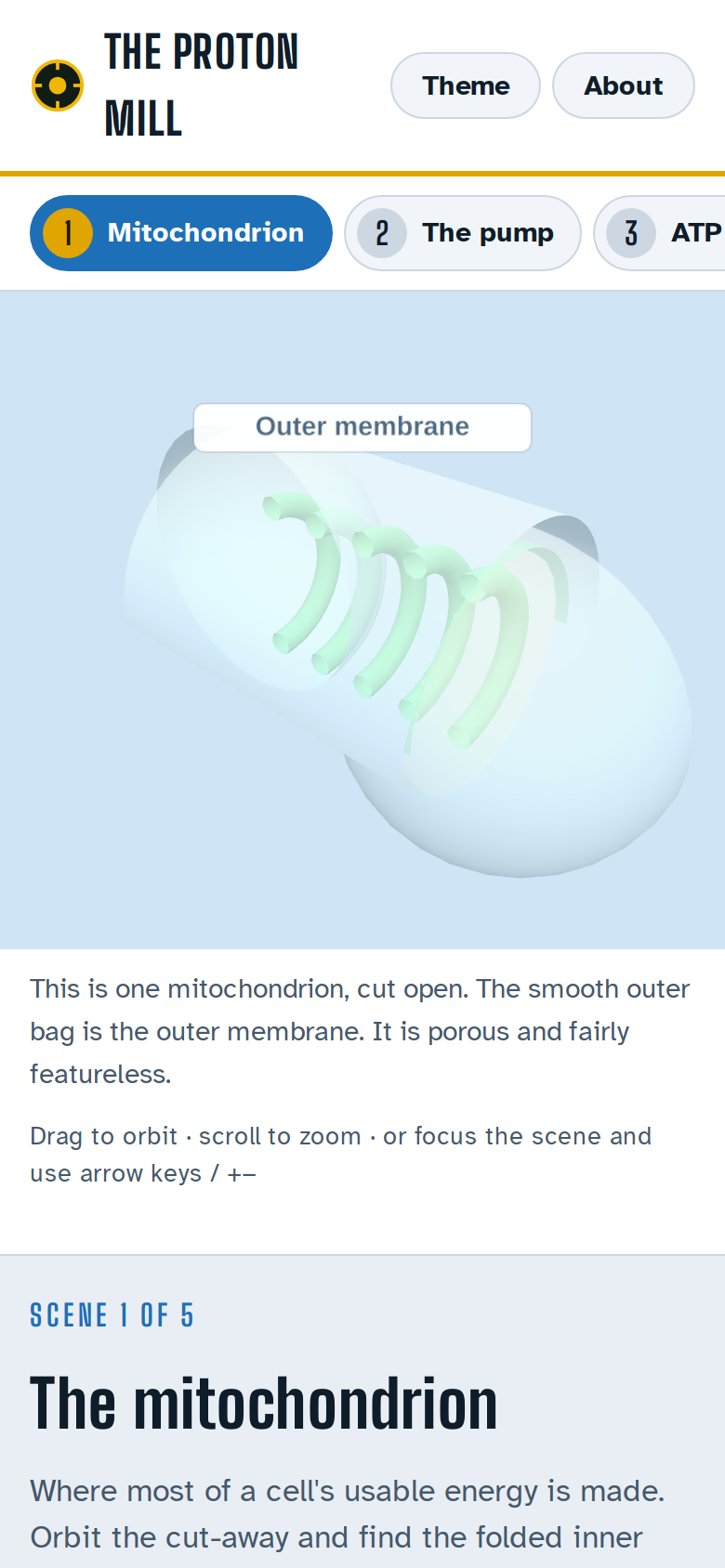 Open this screen: The Proton Mill
 The same recipe, aimed higher: The Proton Mill — a first-year university unit on how the mitochondrion makes ATP, five 3D scenes each with Watch, Why, a quiz, and instructor notes. Built from one brief, the same MP-11 and MP-12. Everyone in it is made up.
How long this took
About thirty minutes on our run: five to brief the architect and read the five-day plan, ten to build and check day three, and the rest comparing it against the bakery showcase to see where a real run lands. The brief is the work; the two prompts do the rest, and the same pair built the university unit from a different paragraph.
When it goes wrong
- It teaches a generic process, not yours. That means it had no source. Paste the SOP, checklist, or safety sheet and name what must be exact — those steps are then kept word for word, not paraphrased.
- The examples feel like a classroom, not a workplace. Say who the learners are and what a real shift looks like. On our run, “floor staff, their own phones, mid-rush” turned worksheet questions into a realistic ticket and a complaint at the counter.
- The course is too long for one sitting. It is built to be a day at a time. Build one day, stop, and run “build next” when you’re ready — nothing is left half-written.
Run it yourself, free
It runs on the AI subscription you already have. The plain prompts paste into any chat, no setup — MP-11 designs the course, MP-12 builds it a day at a time, and a check reads each unit back before it goes out.
Have it done for you
Want it set up and run for you instead? Obsidian Delta, the company, sells that — done-for-you, paid. The Foundation’s work stays free; this is the way to have someone else do the work.
MetaDAX is free. It is built on paid compute. If it helped, a coffee on Ko-fi or a GitHub sponsorship keeps it going.